PRP Injections for Knee Osteoarthritis: Benefits, Risks, and Realistic Expectations

GLP-1 Medications and Muscle Loss: How to Preserve Lean Mass During Medical Weight Loss
August 17, 2026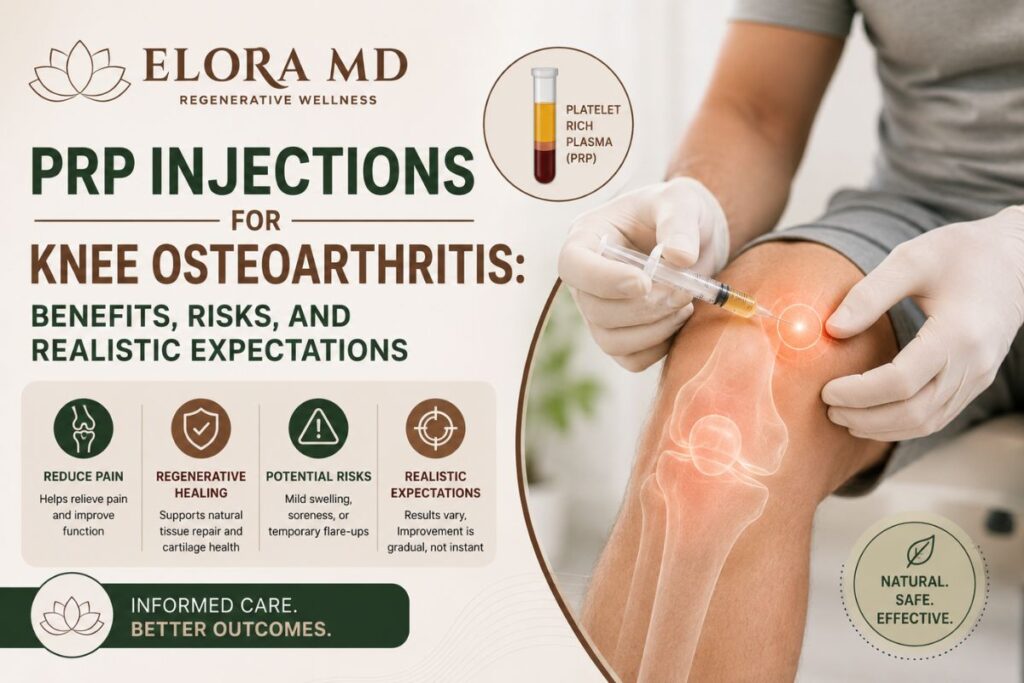
By Dr. Pooja Chopra, MD | Elora MD Regenerative Wellness | Newport Beach, CA
Last medically reviewed: August 2026
Quick answer: Platelet-rich plasma (PRP) is a concentrated preparation of platelets made from a patient’s own blood. For some people with symptomatic knee osteoarthritis, PRP may improve pain and function as part of a comprehensive non-surgical treatment plan. It does not cure osteoarthritis, regrow a normal knee joint, or guarantee that knee-replacement surgery can be avoided.
Knee osteoarthritis can make stairs, exercise, gardening, travel, and even standing from a chair more difficult. When pain, stiffness, or swelling begins to limit daily life, many patients want options that go beyond simply waiting for the condition to worsen.
At Elora MD Regenerative Wellness in Newport Beach, we take a precise, concierge approach to knee pain. That starts with a careful diagnosis, an honest discussion of non-surgical options, and a plan that prioritizes mobility, strength, and long-term function. Platelet-rich plasma (PRP) may be one option for selected patients with knee osteoarthritis- but it should be presented with evidence, transparency, and realistic expectations.
What Is Knee Osteoarthritis?
Knee osteoarthritis is a chronic condition involving the entire joint. It includes progressive changes in articular cartilage, the synovial lining, bone beneath the cartilage, ligaments, menisci, and surrounding muscles. Symptoms may include activity-related pain, stiffness after inactivity, intermittent swelling, reduced range of motion, and difficulty with stairs or prolonged walking.1
Osteoarthritis is often described as “wear and tear,” but that phrase is incomplete. Joint mechanics, prior injury, inflammation, body weight, muscle strength, alignment, genetics, and age can all influence how the condition develops and feels. There is currently no injection that reliably restores a severely arthritic knee to a normal joint; treatment is designed to improve symptoms and function while supporting the health of the structures around the knee.
What Is Platelet-Rich Plasma (PRP)?
PRP is an autologous blood product, meaning it is prepared from your own blood. A small blood sample is processed in a centrifuge to separate and concentrate a portion of the plasma containing platelets. Platelets are best known for helping blood clot, but they also contain signaling molecules and growth factors involved in normal tissue repair.
PRP preparations are not all identical. Platelet concentration, white-blood-cell content, red-blood-cell content, activation method, injected volume, and number of injections can vary between systems and protocols. That variability is one reason PRP research and professional-guideline recommendations have not been fully uniform.
After an intra-articular injection, PRP is thought to influence the local joint environment through signaling pathways that may modulate inflammation and support tissue homeostasis. This is a biologic rationale, not proof that PRP regrows cartilage or reverses osteoarthritis.
What Does the Evidence Say About PRP for Knee Arthritis?
The evidence is promising but not absolute. A 2025 meta-analysis of 18 randomized, placebo-controlled trials involving 1,995 patients found that PRP was associated with clinically relevant improvements in knee function at follow-up points from 1 to 12 months and clinically meaningful pain improvement at 3 and 6 months compared with placebo. Outcomes were influenced by the platelet concentration of the PRP preparation.
At the same time, the American Academy of Orthopaedic Surgeons (AAOS) gives PRP a limited recommendation for knee osteoarthritis, stating that it may reduce pain and improve function. The limited rating reflects inconsistent study methods and meaningful variation in PRP products, treatment protocols, patient selection, and outcome reporting.1
What this means for patients: PRP is a reasonable treatment to discuss for selected knee-osteoarthritis cases. It is not a guaranteed solution, and its benefits should be weighed against established options such as exercise therapy, weight optimization when appropriate, topical or oral medications when safe, bracing, and- in advanced cases- surgical consultation.
PRP vs. Other Non-Surgical Knee Arthritis Treatments
| Treatment | Primary Role | What It May Help | Important Limitations |
| Exercise therapy and strength training | Foundation of non-surgical care | Pain, function, stability, mobility | Requires consistency and an individualized plan; may need modification during flares.1 |
| Weight optimization | Reduces mechanical load when clinically appropriate | Pain and function in people with overweight or obesity | Must protect nutrition and lean mass; not appropriate as a one-size-fits-all strategy.1 |
| NSAIDs or topical anti-inflammatory medicines | Symptom management | Pain and inflammation | Not appropriate for everyone; gastrointestinal, kidney, cardiovascular, and medication-interaction risks require review.1 |
| Corticosteroid injection | Short-term symptom relief | Temporary pain reduction for some patients | Effect is variable and generally time-limited; repeat use should be individualized rather than routine.1 |
| PRP injection | Biologic, non-surgical symptom-management option | Pain and function for some appropriately selected patients | Results vary; no guarantee of cartilage regrowth or surgery avoidance; insurance coverage is often limited.1 2 |
| Knee replacement | Surgical option for advanced, refractory disease | Pain and function in appropriately selected patients | Major surgery with recovery, risks, and a separate candidacy evaluation. |
What Happens During a PRP Knee Injection?
A PRP procedure is typically completed in an outpatient visit. First, a small amount of blood is drawn. The blood is processed in a centrifuge to prepare the PRP, and the physician then injects the preparation into the target knee joint using a sterile technique.
At Elora MD, the treatment decision is individualized. When clinically appropriate, ultrasound guidance can be used to visualize the joint and guide needle placement. A systematic review of Level I studies found that ultrasound-guided knee injections were more accurate than landmark-guided (“blind”) injections across the studied injection sites.
The best post-procedure plan depends on the diagnosis, the PRP protocol, medications, and the patient’s activity level. Most people should plan for a short period of relative activity modification, followed by a graded return to rehabilitation and normal movement based on their clinician’s instructions. Do not assume that an internet protocol or another clinic’s recovery plan is right for you.
Potential Benefits of PRP for Knee Osteoarthritis
For appropriately selected patients, potential benefits may include improved pain, stiffness, function, and ability to participate in rehabilitation or physical activity. Benefits are variable: some patients notice meaningful improvement over weeks to months, while others have limited or no benefit.
Clinical trials have reported benefits that may persist for several months and, in some studies, up to 12 months. That does not mean every patient will experience a year of relief, nor does it establish that PRP prevents or delays knee-replacement surgery.
The most responsible goal is not to promise a “regenerated” knee. It is to determine whether PRP is a reasonable part of a broader plan that helps a patient move better, build strength, manage symptoms, and make a well-informed decision about future care.
Risks, Safety, and FDA Context
Because PRP is prepared from the patient’s own blood, allergic reaction or disease-transmission risk is generally low. However, PRP is still an injection procedure. Potential risks include temporary post-injection pain or swelling, bruising, bleeding, infection, and an incomplete or absent response. A medical review is essential for patients with active infection, certain bleeding or platelet disorders, substantial anemia, relevant medication use, or other conditions that may affect safety or expected benefit.
No regenerative medicine therapy is FDA-approved to treat knee osteoarthritis or to regenerate cartilage. The FDA cautions patients against unsubstantiated claims that regenerative products cure orthopedic conditions. At Elora MD, PRP is discussed as an individualized, non-surgical treatment option for symptom and function management—not as a guaranteed cure or a replacement for appropriate standard care.
Who May Be a Candidate for PRP for Knee Arthritis?
PRP may be worth discussing for adults with symptomatic knee osteoarthritis who have persistent pain or function limits despite an appropriate conservative-care plan, prefer to explore a non-surgical option, and understand the evidence and out-of-pocket considerations. Many patients with mild to moderate osteoarthritis are reasonable candidates for evaluation, but severity on an X-ray alone does not determine candidacy.
A comprehensive evaluation should consider the pattern and location of pain, physical examination, joint stability, alignment, activity goals, prior treatment response, medical history, medications, and imaging when indicated. Some patients with advanced disease may still pursue PRP for symptom management, but expectations should be especially careful: PRP cannot reliably reconstruct a joint with severe structural degeneration.
Knee Pain, Gait Changes, and Back Pain
Knee pain can alter how a person walks, stands, and loads the hips or lower back. Those compensations may contribute to additional discomfort, but new or persistent back, hip, leg, or neurologic symptoms require their own assessment. A thorough musculoskeletal evaluation should not assume that every pain problem is coming from the knee.
Elora MD evaluates the whole movement system when pain affects activity. The goal is to identify the principal pain generator, support safe movement, and coordinate an appropriate plan rather than simply treating one area in isolation.
Why Careful PRP Evaluation Matters
PRP is not a commodity. The treatment plan matters: the diagnosis, preparation protocol, injection technique, informed-consent discussion, and rehabilitation strategy all affect the quality of care. The same is true of deciding when PRP is not the best next step.
Elora MD’s concierge approach to knee osteoarthritis includes:
- A physician-led evaluation of your knee pain, mobility, functional goals, and relevant imaging.
- A discussion of evidence-based non-surgical options, including exercise, strength, weight optimization when appropriate, medication options, bracing, PRP, and BMAC where medically appropriate.
- A transparent review of PRP’s potential benefits, limitations, risks, costs, and alternatives.
- Image-guided procedural planning when clinically appropriate.
- A rehabilitation-minded strategy designed to help you return safely to meaningful activity.
Frequently Asked Questions About PRP for Knee Arthritis
Does PRP regrow cartilage in the knee?
No. PRP has not been shown to regrow a normal knee joint or reliably reverse osteoarthritis. Research suggests it may improve pain and function for some patients, but it should be viewed as a symptom- and function-management option—not a cure.
How long does PRP for knee osteoarthritis last?
Results vary substantially. Studies report potential improvement over several months, with some trials measuring benefits up to 12 months. Your response may depend on arthritis severity, PRP preparation, activity level, rehabilitation, body weight, alignment, and other factors.
Is PRP better than cortisone for knee pain?
Neither treatment is universally “better.” Corticosteroid injections can offer short-term relief for some patients, while PRP may provide longer-lasting improvement for some people with knee osteoarthritis. The best option depends on the diagnosis, health history, treatment goals, and risk profile.
Is PRP FDA approved for knee arthritis?
No PRP treatment is FDA-approved as a cure for knee osteoarthritis or as a cartilage-regeneration treatment. PRP may be discussed as a clinician-directed, non-surgical option; patients should receive clear information about the evidence, alternatives, risks, and costs before deciding.
Who should not receive a PRP injection
Suitability depends on the individual. Active infection, significant bleeding or platelet disorders, some medications, severe anemia, uncontrolled medical conditions, and an incorrect pain diagnosis may make PRP inappropriate or require additional evaluation. A physician should review your medical history and current medications before treatment.
Take the Next Step Toward Better Knee Function
Knee osteoarthritis does not have to mean giving up the activities that make life meaningful. The right plan starts with an accurate diagnosis and realistic, evidence-informed options.
If you are in Newport Beach or greater Orange County and want to explore a concierge, physician-guided approach to knee pain—including whether PRP may fit your goals– contact Elora MD Regenerative Wellness to schedule a comprehensive consultation.