
PRP vs. Stem Cells: What Patients Need to Know About Orthobiologics

Hypermobile? 10 Signs You May Have EDS
July 8, 2026
What Causes Chronic Inflammation? The Hidden Driver of Pain and Aging
August 6, 2026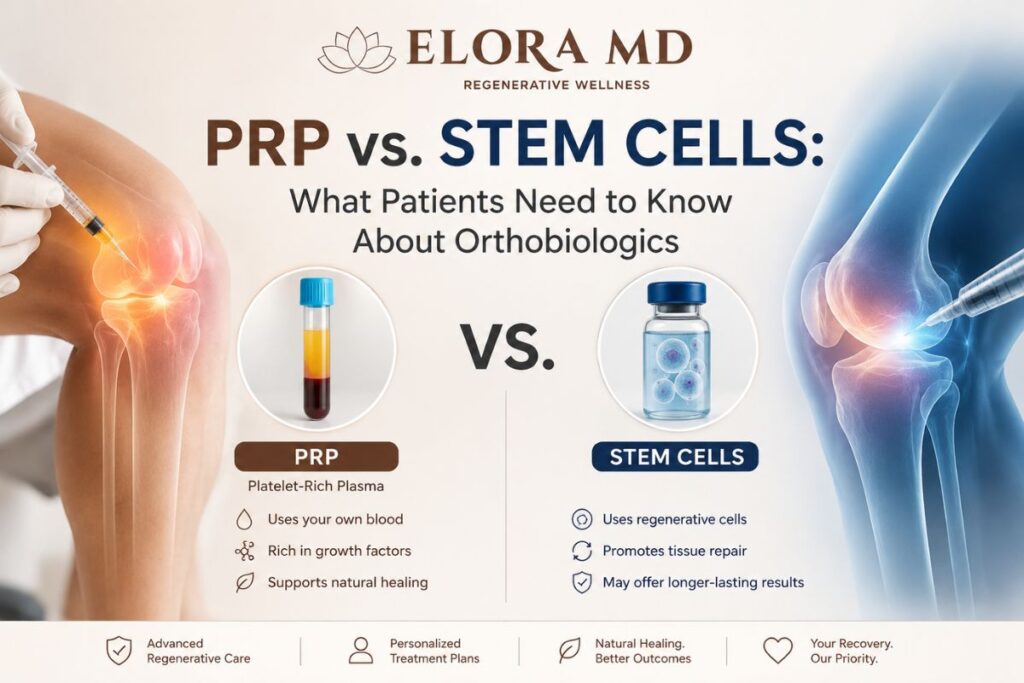
By Dr. Pooja Chopra, MD | Elora MD Regenerative Wellness | Newport Beach, CA | Last medically reviewed: August 2026
If you have been researching regenerative medicine for joint pain, a sports injury, or a chronic musculoskeletal condition, you have almost certainly encountered two terms: PRP and stem cell therapy. Both are frequently discussed as cutting-edge alternatives to surgery, and both aim to harness your body’s own biology to promote healing. But there is a critical distinction between these treatments that most clinics – and most blogs – fail to explain clearly.
At Elora MD Regenerative Wellness in Newport Beach, we believe that an educated patient is an empowered patient. Before you invest in any regenerative therapy, you deserve to understand exactly what is being injected into your body, whether it is FDA-compliant, and why the treatment your provider recommends is the right one for your specific condition.
Let us break it all down.
What Is “Stem Cell Therapy” … and Why the Terminology Matters
The phrase “stem cell therapy” is one of the most searched terms in regenerative medicine. It is also one of the most misused. The FDA has issued clear and repeated guidance that cultured, laboratory-expanded stem cell products are not approved for orthopedic use outside of FDA-supervised clinical trials [1]. Clinics offering amniotic fluid, umbilical cord blood, or Wharton’s jelly injections as “stem cell treatments” are operating outside federal regulations- and the FDA has documented cases of blindness, tumor formation, and life-threatening infections resulting from these unapproved products [1].
What compliant, physician-led regenerative practices actually offer is Bone Marrow Aspirate Concentrate (BMAC) – a procedure that concentrates your own native cells, including mesenchymal stem cells (MSCs), from your own bone marrow. BMAC is the FDA-compliant, evidence-based answer to what patients are truly seeking when they ask about “stem cell therapy” [2].
Understanding this distinction is not just a legal technicality. It is the difference between a safe, scientifically grounded treatment and a potentially dangerous, unregulated one.
An Overview of PRP Therapy
Platelet-Rich Plasma (PRP) is an orthobiologic treatment derived entirely from your own blood. The procedure is straightforward: a small blood sample is drawn from your arm, placed in a centrifuge, and spun to separate the platelets from the red and white blood cells. The resulting platelet-rich concentrate is then precisely injected into the damaged tissue under imaging guidance.
Platelets are the body’s first responders to injury. They carry a dense payload of growth factors- including PDGF, TGF-β, VEGF, and IGF-1- that signal surrounding cells to initiate tissue repair, reduce inflammation, and stimulate collagen synthesis. By delivering a concentrated dose of these growth factors directly to the site of injury, PRP amplifies and accelerates the body’s natural healing cascade.
Because PRP uses only your own autologous blood, the risk of allergic reaction, immune rejection, or disease transmission is virtually eliminated.
When Is PRP the Right Choice?
PRP is an excellent first-line regenerative option for a wide range of conditions, particularly those involving soft tissue and early-to-moderate joint degeneration:
- Mild to moderate osteoarthritis (knee, hip, shoulder)
- Tendinopathy (tennis elbow, Achilles tendinitis, patellar tendinitis)
- Rotator cuff injuries and partial tears
- Ligament sprains and instability
- Muscle strains and chronic sports injuries
- Post-surgical healing support and scar reduction
PRP is also the preferred starting point for patients who are new to regenerative medicine, as the procedure is less invasive, faster, and more cost-effective than BMAC.
What Is BMAC (Bone Marrow Aspirate Concentrate)?
Bone Marrow Aspirate Concentrate (BMAC) is the most advanced autologous orthobiologic available in compliant clinical practice. The procedure involves aspirating a small volume of bone marrow- typically from the posterior iliac crest (the back of the pelvis)- under local anesthesia. This aspirate is then centrifuged in a closed, same-day system to concentrate its regenerative components.
The resulting BMAC is a rich, heterogeneous mixture containing:
- Mesenchymal Stem Cells (MSCs): Native, non-expanded stem cells that promote tissue repair primarily through paracrine signaling- releasing bioactive molecules that reduce inflammation, modulate the immune response, and instruct surrounding cells to regenerate.
- Growth Factors: Including TGF-β1, IGF-1, PDGF, and VEGF, which drive cellular repair and angiogenesis.
- Hematopoietic Progenitor Cells and Platelets: Which contribute to the overall healing environment.
It is important to understand that the MSCs in BMAC are not pluripotent “blank slate” cells that transform into new cartilage or bone on their own. Their primary power lies in their paracrine function- they act as biological conductors, orchestrating the body’s repair processes at a cellular level. This is what makes BMAC so effective for complex, chronic conditions.
Because BMAC is minimally manipulated and used the same day it is harvested, it qualifies as an FDA-compliant tissue product under 21 CFR Part 1271.
When Is BMAC the Right Choice?
BMAC provides a more robust and comprehensive cellular response than PRP, making it the preferred option for more severe or complex conditions:
- Moderate to advanced osteoarthritis
- Significant cartilage loss or chondral defects
- Chronic, non-healing orthopedic injuries
- Complex musculoskeletal disorders with significant tissue degeneration
- Patients who have not achieved sufficient relief with PRP alone
- Those seeking to delay or avoid joint replacement surgery
PRP vs. BMAC: A Side-by-Side Comparison
| Feature | Platelet-Rich Plasma (PRP) | Bone Marrow Aspirate Concentrate (BMAC) |
| Source | Peripheral blood (arm draw) | Bone marrow (iliac crest aspiration) |
| Key Components | Concentrated platelets and growth factors | Native MSCs, hematopoietic cells, platelets, and growth factors |
| Primary Mechanism | Growth factor delivery to stimulate local healing | Paracrine signaling, immunomodulation, and deep tissue repair |
| Procedure Complexity | Simple, minimally invasive, in-office | Minor surgical aspiration under local anesthesia |
| Recovery | Minimal; return to activity within days | Mild soreness at harvest site; return to activity within days to a week |
| Ideal Candidate | Early-to-moderate injuries and arthritis | Moderate-to-severe degeneration; complex chronic injuries |
| FDA Status | Compliant autologous tissue product | Compliant autologous tissue product (21 CFR Part 1271) |
| Relative Cost | Lower | Higher, reflecting greater procedural complexity |
The Elora MD Approach: Regenerative Medicine as a System
At Elora MD Regenerative Wellness, we do not view PRP or BMAC as standalone procedures. We view them as powerful tools within a comprehensive, personalized regenerative strategy. Before recommending any orthobiologic treatment, Dr. Chopra conducts a thorough evaluation that includes:
- Advanced Diagnostic Imaging: To precisely characterize the degree of tissue damage and guide injection targeting.
- Comprehensive Biomarker Analysis: Assessing inflammatory markers, metabolic health, and hormonal status. A body in a state of chronic inflammation or metabolic dysfunction will not heal as effectively from regenerative injections. Optimizing your internal environment first is what separates a good outcome from a great one.
- Personalized Recovery Protocol: Integrating nutrient therapy, and hormone optimization to ensure your body has the cellular raw materials it needs to maximize the healing response from your orthobiologic treatment.
This whole-person, concierge approach is what defines Elora MD. You are not a procedure. You are a patient with a unique biology, unique goals, and a unique path to recovery.
Safety and FDA Compliance: What Every Patient Must Know
Patient safety is non-negotiable. Both PRP and BMAC use your own autologous tissue, making the risk of adverse reactions extremely low. You may experience temporary soreness or swelling at the injection or aspiration site, which is a normal and expected part of the healing process.
A critical warning for patients: Be extremely cautious of any clinic offering “stem cell treatments” using amniotic fluid, umbilical cord blood, Wharton’s jelly, or exosomes for orthopedic conditions. The FDA has explicitly stated these products are not approved for treating any orthopedic condition, including osteoarthritis, tendinitis, or back pain [1]. These products often do not contain viable, functional cells by the time they are administered, and the FDA has received reports of serious adverse events including infections and tumor formation [1].
At Elora MD, we use only FDA-compliant, autologous orthobiologics. We will always explain exactly what we are using, why we are recommending it, and what the evidence says.
Frequently Asked Questions
Are stem cell injections FDA approved for joint pain?
No. Cultured, laboratory-expanded stem cell products are not FDA approved for any orthopedic condition outside of clinical trials. However, Bone Marrow Aspirate Concentrate (BMAC) — which concentrates your own native cells and is processed the same day — is FDA-compliant as a minimally manipulated autologous tissue product.
Is PRP better than BMAC?
Neither is universally “better.” They serve different clinical purposes. PRP is generally the preferred first-line option for mild to moderate soft tissue injuries and early arthritis, while BMAC is reserved for more severe joint degeneration and complex chronic conditions that require a more robust cellular response.
How long does it take to see results from PRP or BMAC?
Regenerative orthobiologics work by stimulating biological tissue repair, not by suppressing symptoms like a steroid injection. Most patients begin noticing meaningful improvements in pain and function within 4 to 8 weeks, with the healing process continuing to progress over 3 to 6 months.
Can PRP and BMAC be used together?
Yes. In certain complex cases, a combination approach- using PRP to prime the tissue environment and BMAC to provide the deeper cellular response- can be considered. Dr. Chopra will discuss whether a combination protocol is appropriate during your comprehensive evaluation.
How do I know if I am a candidate for regenerative medicine?
The best way to determine candidacy is through a thorough consultation that includes a review of your imaging, medical history, metabolic health, and treatment goals. Contact Elora MD to schedule your comprehensive regenerative evaluation.
Take the Next Step Toward a Stronger, More Resilient You
PRP and BMAC represent a profound shift in how we approach musculoskeletal pain and tissue repair- moving away from symptom suppression and toward true, biological healing. But the quality of your outcome depends entirely on the quality of your evaluation, your physician’s expertise, and the comprehensiveness of your treatment plan.
If you are ready to explore FDA-compliant regenerative medicine with a physician who will take the time to truly understand your body and your goals, contact Elora MD Regenerative Wellness today to schedule your consultation.